Hawaii has plenty of things you won’t find just anywhere. Beautiful beaches, dramatic mountain views, roadside fruit stands, and the occasional chicken wandering through a parking lot.
But have you ever noticed something missing from the scenery?
Billboards!
Unlike most of the United States, Hawaii doesn’t have those enormous roadside advertisements encouraging you to buy a new car, call an attorney, or stop for a cheeseburger at the next exit.
And there’s a fascinating reason for that. It involves a group of determined women, a giant pickle advertisement, and one of the more unusual business purchases in Hawaii’s history.
Let’s take a look at how Hawaii became a place where the scenery gets to do the advertising.
Table of Contents
- Hawaii Didn’t Always Look This Way
- The Women Who Took on the Billboard Industry
- Does Hawaii Really Ban All Advertising Signs?
- Why Hawaii’s Billboard-Free Landscape Matters
- How Hawaii Businesses Get Noticed Without Billboards
Hawaii Didn’t Always Look This Way
It’s difficult to imagine today, but in the early 1900s, billboards were becoming a familiar sight around Honolulu.
As automobiles grew more popular and businesses looked for new ways to attract customers, large advertisements appeared along roads and near some of Hawaii’s most recognizable landmarks.
Some signs promoted everyday products, while others advertised businesses and services. The trouble was that these advertisements were competing with something Hawaii already had in abundance: spectacular natural scenery.
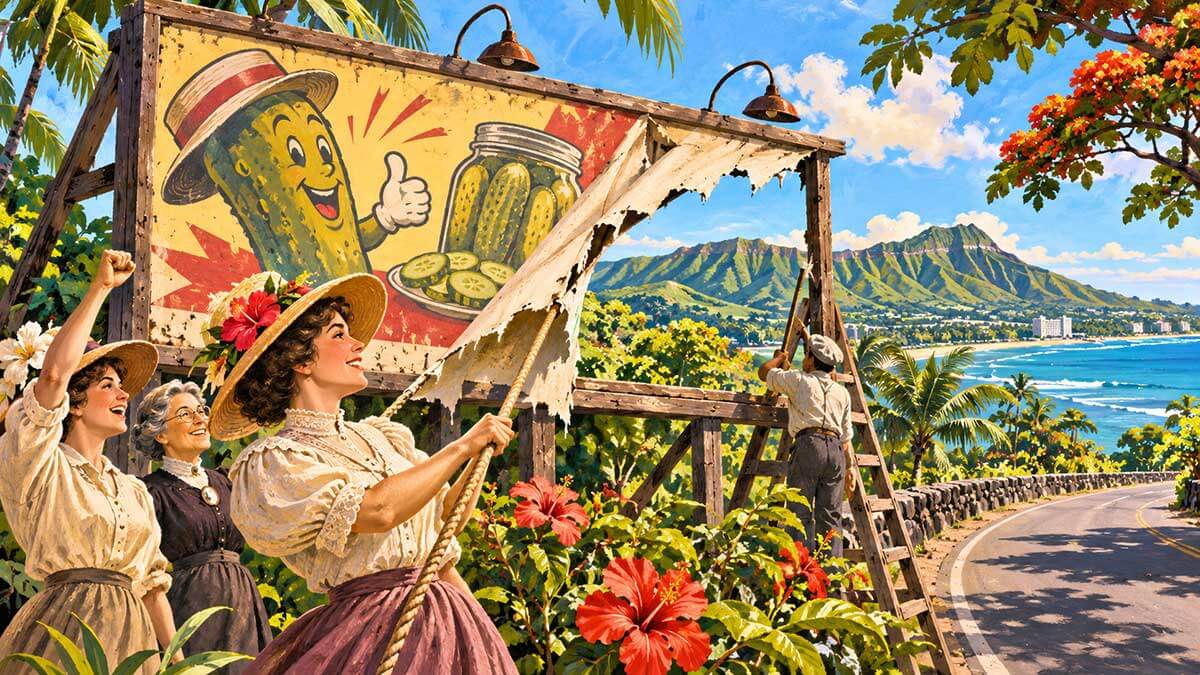
Imagine driving toward Waikiki and having your view of Diamond Head interrupted by a giant advertisement for pickles.
Believe it or not, something remarkably close to that actually happened!
The Women Who Took on the Billboard Industry
In 1912, a group of Honolulu women established an organization called The Outdoor Circle, dedicated to protecting and improving Hawaii’s natural beauty.
One of their early priorities was getting rid of billboards.
They weren’t particularly interested in watching Hawaii’s beautiful landscapes disappear behind advertisements. So they began organizing public campaigns, encouraging boycotts, and persuading businesses to remove their signs.
One especially memorable confrontation involved a large Heinz Dill Pickle advertisement along the road to Waikiki. According to a historical account published by Honolulu Civil Beat, the billboard partially blocked motorists’ view of Diamond Head.
The women weren’t impressed.
They organized a boycott, and Heinz eventually removed the advertisement.
But The Outdoor Circle had bigger plans than convincing individual businesses to take down their signs.
They decided to buy the billboard company itself!
Members raised approximately $4,000 to purchase the Honolulu Poster Service, one of the remaining billboard businesses, and shut it down.
Talk about eliminating the competition!
The group’s efforts helped bring about territorial legislation restricting billboards in 1927. Their campaign established a tradition of billboard control that has continued through Hawaii’s years as a U.S. territory and into statehood.
Today, The Outdoor Circle continues advocating for Hawaii’s scenery, trees, green spaces, and protection from intrusive outdoor advertising.
Does Hawaii Really Ban All Advertising Signs?
Not exactly.
Hawaii’s longstanding restrictions primarily target traditional outdoor billboards advertising businesses or products away from where they’re sold.
That doesn’t mean a restaurant can’t display its name above the entrance or a local shop can’t put up an appropriate business sign.
Under Hawaii Revised Statutes § 445-112, certain outdoor signs are permitted, including signs identifying businesses on their own premises, some property-sale signs, official notices, and other specified categories.
Additional state and county regulations determine what is allowed in particular circumstances.
The difference is fairly simple: a sign identifying the business you’re standing in front of is not the same thing as a giant billboard advertising a business miles down the road.
And Hawaii isn’t entirely alone. Vermont, Maine, and Alaska also have longstanding restrictions prohibiting conventional billboards.
Still, Hawaii’s history is particularly interesting because its billboard campaign began long before Hawaii officially became the nation’s 50th state in 1959.
Why Hawaii’s Billboard-Free Landscape Matters
Think about some of Hawaii’s most memorable drives.
The winding roads along Kauai’s North Shore. The coastal scenery on Maui. The dramatic mountains and valleys of Oahu. The open landscapes of Hawaii Island.
Now imagine those views interrupted every few miles by towering advertisements for insurance, fast food, or the latest automobile sale.
Not quite the same experience, is it?
Hawaii’s billboard restrictions help preserve something that residents and visitors both value: the ability to enjoy the islands without constant roadside advertising competing for attention.
There is something refreshing about that.
Of course, businesses still need customers, and advertising is an important part of keeping a company successful. Hawaii’s approach simply places limits on where certain kinds of advertising can appear.
Which raises an interesting question.
If businesses can’t rely on giant roadside billboards, how do they make sure people find them?
How Hawaii Businesses Get Noticed Without Billboards
Fortunately, local businesses have plenty of other ways to reach customers.
Word of mouth, personal recommendations, storefront signage, community relationships, and local advertising have always played important roles in Hawaii’s economy.
Today, the internet provides another important way for businesses to introduce themselves.
Someone planning a Kauai vacation might search Google for a kayak rental. A homeowner on Oahu might look for a reliable contractor. A visitor on Maui might search for a nearby restaurant.
Instead of spotting a billboard along the highway, customers often discover businesses through websites, Google Maps, online reviews, and search results.
That’s where Shaka Web Design Services comes in.
We love the little things that make Hawaii different. We’ve explored everything from Kauai’s famous chickens to the islands’ remarkable love affair with SPAM. And we’re equally passionate about helping small businesses succeed.
At Shaka Web Design Services, we help business owners establish and maintain their online presence through professional website design, search engine optimization, hosting, and ongoing technical support.
Our approach is simple: you already have a business to run, and that comes with enough responsibilities. You shouldn’t have to spend your valuable time learning the technical details of websites and search engines just to help customers find you.
You focus on running your business. We’ll handle the website and the technology behind it.
After all, Hawaii worked pretty hard to get rid of those giant billboards. We certainly don’t need to bring them back just to help a good local business get noticed!
If your business could use a little help standing out online, contact Shaka Web Design Services and let’s talk story.